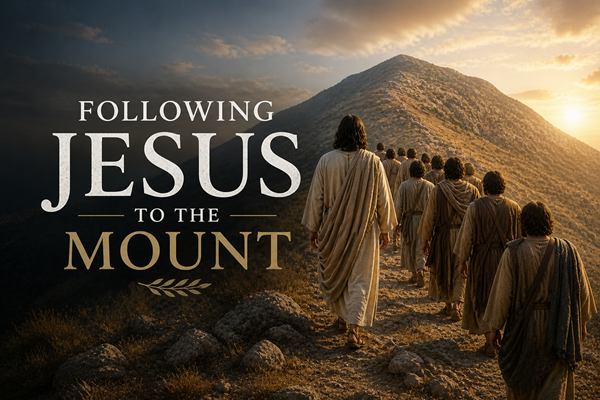
FOLLOWING JESUS TO THE MOUNT
MEMORY VERSE: “And seeing the multitudes, he went up into a mountain: and when he was set, his disciples came unto him.” Matthew 5: 1
TEXT: Matthew 5 :1-48; Matthew 14:23, Matthew 17: 1-9; Mark 3:13-14; Matthew 24:3; Luke 6:12; Matthew 28: 16
INTRODUCTION
The words “mount” and “mountain” essentially mean the same thing. So, they would be used interchangeably in this study. According to the Cambridge English Dictionary, a mountain is a raised part of the earth surface, much larger and steeper than a hill. So, geographically, a mountain is significantly above the surrounding land or area; typically featuring a height greater than 300 to 600 meters. Based on this definition, a mountain is not a common place; it has an uncommon height and nature. People who go up the mountain do so intentionally.
However, in the Christian context, a mountain or mount refers to a special place of seclusion, a place above the normal or ordinary, a peak or height where man meets with God. Jesus went there several times in His life time to meet with His Father (Luke 6:12). Great prophets and disciples in scriptures equally went there to meet with God for personal encounters, assignments, revelations, and direction. For example, Moses (Exodus 19:3,20; 20:1- 17; 24:12-18; 34:28-35) and Elijah (1 Kings 18:19-42; 19:8-18). The disciples of Jesus were equally not an exception; they met with Him several times on the mount (Mark 9:2-8- the transfiguration; Matthew. 28:16- 20- the great commission; Matthew. 5: 1-42- sermon on the mount).
A mountain could therefore be said to be a place of spiritual significance. Conversely, for the world today, and people of the world, mountains are seen to be problems, difficulties and challenges. Sayings like “Don’t make a mountain out of mole hill ….”, can make mountains seem as impossible feats and situations. But for children of God, mountains are places of creation, where impossibilities are made possible. Our Lord Jesus was drawn to mountains as well as our Fathers of Faith, who equally climbed mountains for the fulfillment of their destinies. In the Old Testament before Christ, Abraham went up the mountain to sacrifice his son (Genesis. 22:2-12), Moses went up the Mount Sinai to receive the 10 commandments (Exod. 31:18), and Elijah went up to Mounts Carmel and Sinai and there was a tremendous display of God’s power (1 Kings 18 & 19).
The mountain is therefore, where the heavens and the earth collide for divine transformation through God’s presence. Jesus confirmed this by continuing with this mystery as seen in several scriptures referenced in this study. Before we dive into this further, we need to understand the spiritual significance of a mountain to the Church.
Spiritual Significance of the Mountain
From the spiritual lens or point of view, the mountain or mount symbolizes several spiritual things. Some of which are hereby highlighted below:
- A place or location of personal encounter (Exodus 3:1-6- mountain of God; 1 King 19:11-13)
- A place or location where God meets with Men (1 Kings 18:19-39; Exodus 19:16-20)
- A place of prayer (Luke 6:12; Luke 22:39-46)
- A place where we generate power and build spiritual capacity (Luke 6:12-18)
- A place of God’s radical presence (Exodus 24:16; 33:9-11)
- A place where we can have revelations with God (Matthew 17:3-6)
- A place of divine calling (Luke 6:12-16)
- A place of divine teaching, where we learn from God (Matthew 5:1-48)
- A place where divine responsibilities are given (Matthew 28:16-20)
- A place of sacrifice and provision (Genesis 22:1-14)
- A place of victory/expression of God’s power (1 Kings 18:20- 46)
- A place of temptation and supremacy of the word (Matthew 4:8-10
Thus, the mount is a place every Christian should desire, and sought to visit because of its numerous benefits.
A LOOK AT A MAJOR MOUNTAIN EXPERIENCE WITH JESUS
As seen already, a mountain is a very significant place in the Christian faith. In fact, the word mount or mountain appeared over 500 times in the bible because many major encounters/events between God and man took place there. Nevertheless, going further with this study, we will look in-depth at just one major encounter/event that took place on a mount in the bible that is still of great relevance to us today. That event is the Beatitude seen in Matthew 5:1–48.
The teachings of this mountain-experience can help every Christian follow Jesus and be blameless, hence its choice. On that mount, we saw a powerful moment in the ministry of Jesus, where men were around him, but only the true disciples followed Him up the mountain (Matthew 5:1). This shows that many people recognize Jesus, but only a few truly follow Him up the mountain to higher grounds. Salvation brings us to Jesus, but discipleship requires us to follow Him all the way upward to perfection and fulfillment. Additional notable things to take/learn from this mountain experience are numerated bellow:
- The Call to Come Hither (Matthew 5:1)
On this mount, there was an invitation from Jesus to every Christian to come up with Him to the mountain (a higher spiritual realm). This invitation was silent, not forceful, but powerful. The true disciples understood what was required and went closer up the mountain. But the multitude did not understand. So, they stayed at the base of the mountain. Following Jesus is always intentional and requires efforts. You can only get mountain experience/revelation when you go up the mountain. Revelation 4:1b: “come up hither, and I will shew thee things which must be hereafter.”
- The Required Kingdom Character
On this mount, Jesus taught the disciples the character expected of those who follow Him. As instructed, followers are expected to exhibit the following:
- Be poor in spirit (depend on God – Matthew 5:3)
- Be meek (submissive, gentle, humble – Matthew 5:5)
- Show hunger for righteousness (Matthew 5:6)
- Be merciful (Matthew 5:7)
- Be pure in heart (Matthew 5:8)
- Be peacemakers (Matthew 5:9)
- Be able to endure persecution (Matthew 5:10-11)
The mount is where God reshapes our inner life. Before God makes use of us publicly, He transforms us privately on the mount.
- Christian Responsibilities to the World (Matthew 5:13–16)
On the mount, you are changed not just for yourself, but for the world at large (Romans 8:19). You become the salt of the earth; preserving righteousness in a decaying world. You also become the light of the world; shining truth in moral darkness. The mount is not an escape from the world, but a place of preparation to influence the world.
- A Definition of Inner Righteousness (Matthew 5: 17–48)
On the mount, Jesus moved from the emphasis of external righteousness of the pharisees to internal transformation of every Christian, which is key. He taught on anger, lust, integrity, forgiveness and love. The message was clear, following Jesus is not just behaviour modification, but a circumcision of the heart. The mount confronts hidden anger, secret lust, quiet bitterness, and conditional love. - The Call to Perfection (Matthew 5: 44–48)
Jesus ended His teachings with a radical command of perfection; love your enemies, bless those who curse you, and pray for those who persecute you. Anyone can love friends. Only mount-followers love enemies. Why? Because when you follow Jesus upward, you begin to resemble Him and the Father, you attain the state of perfection (Matthew 5:48).
Conclusion
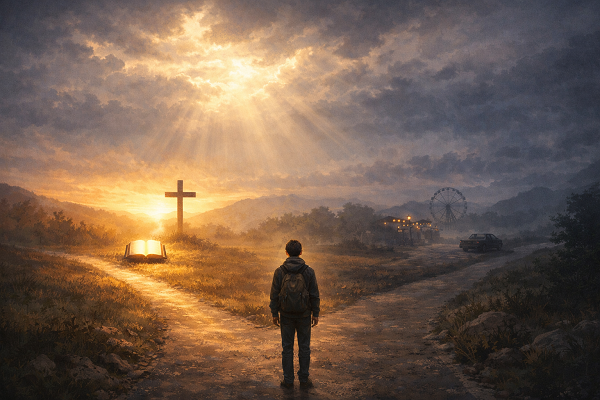
The mountain experience in Matthew chapter five (5) showed that ordinary people (the multitude) watched Jesus, while His disciples followed Him up. The silent invitation to follow Jesus up the mount still stands today. After this teaching, the question is, will you remain in the comfort zone of the multitude or will you follow Him up the mountain for transformation? The mount is not an easy or common place, but it is a place of power that has capacity to give your life direction, change your character, define your calling, reveal true righteousness to you and ultimately prepare you for eternity with Jesus.