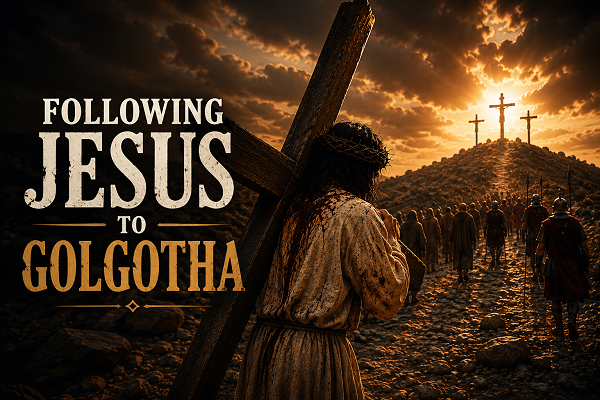

FOLLOWING JESUS TO DISCIPLESHIP
MEMORY VERSE: “Then said Jesus unto his disciples, If any man will come after me, let him deny himself, and take up his cross, and follow me.” – Matthew 16:24
TEXT: Matthew 4:18–22; Matthew 28:18–20; Luke 14:25–33; John 8:31–32;
Acts 2:41–47; 2 Timothy 2:2
INTRODUCTION
Many people follow Jesus as Saviour, but not everyone follows Him into discipleship. Salvation is the beginning of the journey; discipleship is the continuation. Jesus did not only call people to believe in Him; He called them to follow Him. In Matthew 4:19, He said, “Follow me, and I will make you fishers of men.” That call was not merely to association, but to transformation. Discipleship is the intentional, lifelong process of following Jesus Christ, becoming more like Him in thoughts, words, and actions through the power of the Holy Spirit. A disciple is more than a church attendee. A disciple is a learner, a follower, and one who is being shaped into the image of Christ (Romans 8:29). Following Jesus to discipleship means committing to spiritual growth, obedience, discipline, and multiplication. It is a deliberate journey from conversion to Christlikeness. Discipleship is not accidental. It is intentional. It requires surrender, submission, and spiritual training. Jesus invested time in the twelve (Mark 3:14), teaching them, correcting them, and preparing them to continue His work. Likewise, He calls every believer today into that same path of discipleship.
FOLLOWING JESUS TO DISCIPLESHIP IS A DECISION TO LEAVE AND LEARN
Matthew 4:18–22; Luke 5:27–28 When Jesus called Peter, Andrew, James, and John, “they straightway left their nets, and followed him” (Matthew 4:20). When Levi was called, “he left all, rose up, and followed him” (Luke 5:28).
We see a pattern:
The Call, The Decision and The Action. The decision of discipleship is reflected in the action. Discipleship begins with leaving. The fishermen left their nets. Levi left his tax office. Elisha left his oxen (1 Kings 19:20–21). Following Jesus to discipleship requires separation from old patterns and sinful lifestyles. Discipleship is a process of becoming. Jesus does the making, but the disciple must do the following.
This decision:
- Is personal: No one can decide it for you.
- Requires sacrifice: Something must be left behind.
- Is immediate: Delayed obedience weakens commitment.
- Is faith-based: The future is not fully revealed.
- Leads to transformation: “I will make you…” (Matthew 4:19).
FOLLOWING JESUS TO DISCIPLESHIP IS CONTINUING IN HIS WORDJohn 8:31–32 Then said Jesus to those Jews which believed on him, If ye continue in my word, then are ye my disciples indeed; And ye shall know the truth, and the truth shall make you free.
Jesus clearly defined discipleship. It is not mere profession; it is continuation. The proof of true discipleship is consistency in the Word. A disciple is teachable. A disciple submits to correction. A disciple values truth over feelings. Without commitment to the Word, there can be no real discipleship.
To continue in His Word means:
- Studying Scripture regularly (2 Timothy 2:15).
- Obeying what is learned (James 1:22).
- Allowing the Word to shape conduct (Psalms 119:105).
- Letting truth correct error (Hebrews 4:12).
- Growing in knowledge and grace (2 Peter 3:18).
FOLLOWING JESUS TO DISCIPLESHIP IS A CALL TO COUNT THE COST
Luke 14:27–33 Jesus said, “Whosoever doth not bear his cross, and come after me, cannot be my disciple.” He further spoke about counting the cost before building a tower. Discipleship is costly. It may cost: Comfort, Reputation,
Relationships (Matthew 10:37), Personal ambition, Security. The rich young ruler desired eternal life but was unwilling to part with his possessions (Mark 10:21–22). He wanted blessing without surrender. Discipleship demands complete allegiance. The cost is high, but the reward is eternal (Matthew 19:29).
FOLLOWING JESUS TO DISCIPLESHIP IS SUBMISSION TO HIS LORDSHIP – Luke 6:46 “And why call ye me, Lord, Lord, and do not the things which I say?” A disciple does not only admire Jesus; he obeys Him. Calling Jesus “Lord” means recognizing His authority over every area of life. Discipleship without obedience is contradiction. A disciple listens and follows instruction.
Submission involves:
- Obedience to His commands (John 14:15).
- Trusting His leadership (Proverbs 3:5–6).
- Yielding personal will to divine will (Luke 22:42).
- Accepting discipline (Hebrews 12:6).
- Living under His authority daily.
FOLLOWING JESUS TO DISCIPLESHIP PRODUCES SPIRITUAL COMMUNITY – Acts 2:42–47
The early believers “continued steadfastly in the apostles’ doctrine and fellowship.” Discipleship thrives in community. The early church shared life together, learning, praying, breaking bread, and supporting one another.
Discipleship is a real love foundation Discipleship includes:
- Commitment to fellowship (Hebrews 10:25).
- Accountability among believers (Galatians 6:1–2).
- Corporate worship and prayer (Acts 1:14).
- Spiritual encouragement (1Thessalonians 5:11).
- Growth through mutual sharpening (Proverbs 27:17).
FOLLOWING JESUS TO DISCIPLESHIP INVOLVES MULTIPLICATION – Matthew 28:19–20; 2 Timothy 2:2
Jesus’ final command was, “Go ye therefore, and teach all nations.” Discipleship does not end with personal growth; it continues through multiplication. Paul instructed Timothy, “The things that thou hast heard of me… commit thou to faithful men, who shall be able to teach others also” (2 Timothy 2:2). A disciple who does not disciple others has not fully embraced the Great Commission. What is your path in your local assembly? Are you increasing or scattering the body of Christ? Disciples are builders. Following Jesus to discipleship is taking upon you the mandate to continue the Save-the-world Jesus’ Ministry.
True disciples:
- Share the gospel.
- Mentor others.
- Model Christlike living.
- Teach sound doctrine.
- Reproduce spiritually.
CONCLUSION
Following Jesus to discipleship is more than emotional excitement; it is intentional commitment. It begins with leaving, continues with learning, grows through obedience, thrives in community, and culminates in multiplication. Jesus did not say, “Make converts only.” He said, “Make disciples.” The call still stands today.
The question is not, “Are you saved?”
The deeper question is, “Are you a disciple indeed?” (John 8:31). May we not only follow Jesus for blessings, but follow Him into lifelong discipleship.